BACK
May 5, 2026
EVs Remaining SOH Prediction
Batteries degrade nonlinearly, and standard models often make the prediction problem worse by ignoring the physics. That produces trajectories that are statistically plausible but physically impossible, like a battery recovering capacity it already lost.
This was the central problem in our deep learning course project at KFUPM, completed with Abdulelah Shewoil and Jehad Albarrak.
The Dataset
We used the Oxford Battery Degradation Dataset, 8 lithium-ion cells (740 mAh each), cycled to end of life under an Artemis urban driving profile at a controlled 40°C. A characterization cycle was run every 100 cycles to measure actual capacity, and that's the data we worked with.
Approach
We evaluated both GRU and LSTM architectures, comparing compressed and raw-resampled cycle representations across different feature combinations.
Sliding window tokenization.
Rather than feeding the model a single snapshot, we used 12 historical checkpoints to predict the remaining SOH trajectory. The model sees how the battery has been behaving, not just its current state.
Physics-informed loss function.
We added a monotonicity constraint to the loss by penalizing the model whenever it predicted SOH increasing. Batteries don't recover capacity. The constraint enforces that.
Training used leave-one-cell-out cross-validation across Cell1–Cell7, with Cell8 held out as the unseen final test cell.
Results
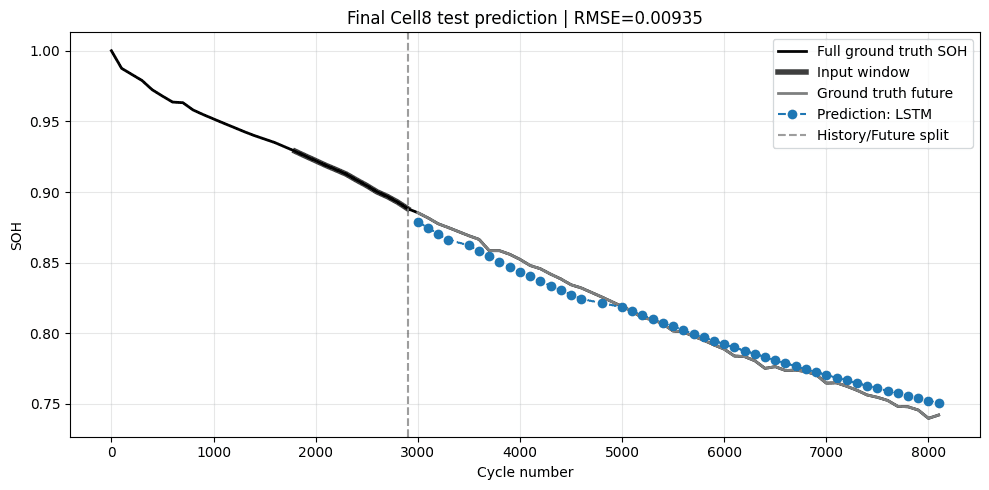
The best configuration was an LSTM using compressed charge cycle data with voltage, capacity, and capacity-end features resulting in 43 features in total. Tested on the unseen Cell8, it achieved an RMSE of 0.0093 on the final test and 0.0062 on the selected forecast window. With the monotonicity constraint held, the model produced strictly decreasing SOH trajectories, which would not have been guaranteed without it.
What We Learned
Voltage alone proved sufficient as a predictive input. After experimenting with combinations of voltage, capacity, and temperature, we found that temperature hurt more than it helped. Because the experiment held temperature constant at 40°C, it carried no real degradation signal. It was a controlled variable, not an informative one.
Resampling to 21 points per cycle was sufficient to describe the full SOH behaviour. The initial 500-point sampling introduced noise that obscured the subtle mid-life slowdown in degradation the model needed to capture.
Most of the work ended up being on the data side such as extraction, feature selection, preprocessing, and sample construction. The modeling itself was relatively straightforward once the pipeline was clean.
A Note on Temperature Generalization
One question we explored was whether the model could generalize to higher temperature conditions like Saudi Arabia exceeding 40°C. The answer was no, and the reason is structural: a model trained at one fixed temperature has no thermal variation to learn from, making extrapolation physically ungrounded.
This is worth stating more broadly. Virtually all public battery degradation datasets are collected under controlled laboratory temperatures, most at a single fixed point ranging between 20°C and 40°C. Datasets that do vary temperature rarely exceed that range. The result is a systematic gap in the field, models trained on available data have no meaningful basis to predict degradation behaviour in high-temperature operating environments. It's not a modeling limitation. It's a data one.
Reference
Pepe, S., Liu, J., Quattrocchi, E., & Ciucci, F. (2022). Neural ordinary differential equations and recurrent neural networks for predicting the state of health of batteries. Journal of Energy Storage, 50, 104209. https://doi.org/10.1016/j.est.2022.104209
Mohammed Aldosari
AI Engineer · Riyadh
May 5, 2026
EVs Remaining SOH Prediction
Batteries degrade nonlinearly, and standard models often make the prediction problem worse by ignoring the physics. That produces trajectories that are statistically plausible but physically impossible, like a battery recovering capacity it already lost.
This was the central problem in our deep learning course project at KFUPM, completed with Abdulelah Shewoil and Jehad Albarrak.
The Dataset
We used the Oxford Battery Degradation Dataset, 8 lithium-ion cells (740 mAh each), cycled to end of life under an Artemis urban driving profile at a controlled 40°C. A characterization cycle was run every 100 cycles to measure actual capacity, and that's the data we worked with.
Approach
We evaluated both GRU and LSTM architectures, comparing compressed and raw-resampled cycle representations across different feature combinations.
Sliding window tokenization.
Rather than feeding the model a single snapshot, we used 12 historical checkpoints to predict the remaining SOH trajectory. The model sees how the battery has been behaving, not just its current state.
Physics-informed loss function.
We added a monotonicity constraint to the loss by penalizing the model whenever it predicted SOH increasing. Batteries don't recover capacity. The constraint enforces that.
Training used leave-one-cell-out cross-validation across Cell1–Cell7, with Cell8 held out as the unseen final test cell.
Results
The best configuration was an LSTM using compressed charge cycle data with voltage, capacity, and capacity-end features resulting in 43 features in total. Tested on the unseen Cell8, it achieved an RMSE of 0.0093 on the final test and 0.0062 on the selected forecast window. With the monotonicity constraint held, the model produced strictly decreasing SOH trajectories, which would not have been guaranteed without it.
What We Learned
Voltage alone proved sufficient as a predictive input. After experimenting with combinations of voltage, capacity, and temperature, we found that temperature hurt more than it helped. Because the experiment held temperature constant at 40°C, it carried no real degradation signal. It was a controlled variable, not an informative one.
Resampling to 21 points per cycle was sufficient to describe the full SOH behaviour. The initial 500-point sampling introduced noise that obscured the subtle mid-life slowdown in degradation the model needed to capture.
Most of the work ended up being on the data side such as extraction, feature selection, preprocessing, and sample construction. The modeling itself was relatively straightforward once the pipeline was clean.
A Note on Temperature Generalization
One question we explored was whether the model could generalize to higher temperature conditions like Saudi Arabia exceeding 40°C. The answer was no, and the reason is structural: a model trained at one fixed temperature has no thermal variation to learn from, making extrapolation physically ungrounded.
This is worth stating more broadly. Virtually all public battery degradation datasets are collected under controlled laboratory temperatures, most at a single fixed point ranging between 20°C and 40°C. Datasets that do vary temperature rarely exceed that range. The result is a systematic gap in the field, models trained on available data have no meaningful basis to predict degradation behaviour in high-temperature operating environments. It's not a modeling limitation. It's a data one.
Reference
Pepe, S., Liu, J., Quattrocchi, E., & Ciucci, F. (2022). Neural ordinary differential equations and recurrent neural networks for predicting the state of health of batteries. Journal of Energy Storage, 50, 104209. https://doi.org/10.1016/j.est.2022.104209
Mohammed Aldosari
AI Engineer · Riyadh
May 5, 2026
EVs Remaining SOH Prediction
Batteries degrade nonlinearly, and standard models often make the prediction problem worse by ignoring the physics. That produces trajectories that are statistically plausible but physically impossible, like a battery recovering capacity it already lost.
This was the central problem in our deep learning course project at KFUPM, completed with Abdulelah Shewoil and Jehad Albarrak.
The Dataset
We used the Oxford Battery Degradation Dataset, 8 lithium-ion cells (740 mAh each), cycled to end of life under an Artemis urban driving profile at a controlled 40°C. A characterization cycle was run every 100 cycles to measure actual capacity, and that's the data we worked with.
Approach
We evaluated both GRU and LSTM architectures, comparing compressed and raw-resampled cycle representations across different feature combinations.
Sliding window tokenization.
Rather than feeding the model a single snapshot, we used 12 historical checkpoints to predict the remaining SOH trajectory. The model sees how the battery has been behaving, not just its current state.
Physics-informed loss function.
We added a monotonicity constraint to the loss by penalizing the model whenever it predicted SOH increasing. Batteries don't recover capacity. The constraint enforces that.
Training used leave-one-cell-out cross-validation across Cell1–Cell7, with Cell8 held out as the unseen final test cell.
Results
The best configuration was an LSTM using compressed charge cycle data with voltage, capacity, and capacity-end features resulting in 43 features in total. Tested on the unseen Cell8, it achieved an RMSE of 0.0093 on the final test and 0.0062 on the selected forecast window. With the monotonicity constraint held, the model produced strictly decreasing SOH trajectories, which would not have been guaranteed without it.
What We Learned
Voltage alone proved sufficient as a predictive input. After experimenting with combinations of voltage, capacity, and temperature, we found that temperature hurt more than it helped. Because the experiment held temperature constant at 40°C, it carried no real degradation signal. It was a controlled variable, not an informative one.
Resampling to 21 points per cycle was sufficient to describe the full SOH behaviour. The initial 500-point sampling introduced noise that obscured the subtle mid-life slowdown in degradation the model needed to capture.
Most of the work ended up being on the data side such as extraction, feature selection, preprocessing, and sample construction. The modeling itself was relatively straightforward once the pipeline was clean.
A Note on Temperature Generalization
One question we explored was whether the model could generalize to higher temperature conditions like Saudi Arabia exceeding 40°C. The answer was no, and the reason is structural: a model trained at one fixed temperature has no thermal variation to learn from, making extrapolation physically ungrounded.
This is worth stating more broadly. Virtually all public battery degradation datasets are collected under controlled laboratory temperatures, most at a single fixed point ranging between 20°C and 40°C. Datasets that do vary temperature rarely exceed that range. The result is a systematic gap in the field, models trained on available data have no meaningful basis to predict degradation behaviour in high-temperature operating environments. It's not a modeling limitation. It's a data one.
Reference
Pepe, S., Liu, J., Quattrocchi, E., & Ciucci, F. (2022). Neural ordinary differential equations and recurrent neural networks for predicting the state of health of batteries. Journal of Energy Storage, 50, 104209. https://doi.org/10.1016/j.est.2022.104209
Mohammed Aldosari
AI Engineer · Riyadh